[ADD PIC] On the day we shot the chase scene, Annie, Hayley and the 2 actors came round my house because the park is up that road. Annie began doing Jordan's make-up first; she applied liquid latex and then baby powder and make-up on his hands to make them look old and as if he had beaten the victim before she ran away. Then she put "Adore + Endure Me" and "A+E" on his face.
Next, Annie started work on the victim's face, making it look bruised and bloody, as if the killer had beaten her. The victim also had smudged lipstick and mascara on her face, to make her look more superficial and emphasize the fact she is a prostitute.
Annie had made the pregnant belly using a pillowcase filled with stuffing and on the day, when our actor tried it on, it was too big for her. So after many attempts, I managed to take out enough stuffing so it was fitted her but still look large as if she was quite heavily pregnant.
Also, Hayley put the actor's hair in a messy bun which had loosened and strands were coming out.
This is what our 2 actors looked like at the end of hair and make-up. Overall, the preparation went successfully as our actors looked how we wanted them to, especially the special fx make-up on the killer which looked good after Annie had tried out so many variations of it.
After, we made our way to the park and we took up a ladder so we could film the high angle shots, special fx make-up to the victim's arm wound which comes half way in the chase scene, the story board to direct the actors and the camera and tripod to film with. When we got up there, luckily we found a trolley so we used that to put our stuff in, including actors coats as it was very cold. The trolley was greatly beneficial to us as we kept moving around in the wooded area.
I filmed the first shot, the establishing shot of the victim running away, using the tripod and this was hard because I had to partly hold the tripod as the ground was slightly unstable because it was extremely muddy. The week we filmed, it had been raining a lot, so when we were all moving around the park, it was very difficult. However, luckily the rest of our opening will be inside Hayley's shed. As well, the path the victim was running down was a popular path for people to walk down with their dogs so there was a lot of waiting for us so that in the shot there was no one else apart from the victim.
When we began filming (around 2pm), it was relatively bright; bright enough so we did not need to use additional artificial lighting. In many of the first scenes we used natural lighting, however at around 4pm it got very dark so when we filmed the last few shots where the killer catches the victim, we used artificial lighting to illuminate the actor's faces for the camera.
We were not expecting the sky to get as dark as it did within half an hour so our last shots are quite dark. My group and I decided to incorporate this into the story - that the length of the chase had been going on for quite long, so when the killer finally caught her, it was late. This will make surprise the audience that the killer is that determined to get the victim, and will also emphasize the killer's agility juxtaposing the victim and how she tired after a while.
Before it got dark, we filmed the scene where the victim got cut by a branch and we used the ladder for this. The ladder was placed on muddy ground and I was on it so Hayley had to hold the ladder while I filmed. The ladder was against a tree and the branches were blocking the camera so I had to break off a few, but I kept some in the way to make the scene seem more realistic. Being on the ladder was not a problem as it was actually quite stable without Hayley supporting it. Also, Annie and Hayley poured some fake blood on the branch and the leaves underneath and I filmed the killer approaching this. Meanwhile, Annie was applying the victim's wound from the branch so we saved time and when that was done, we filmed her being cut by the branch.
After we finished filming that, it began to get very dark, as mentioned, so when we found a thick enough tree for the victim to hide behind, we needed artificial lighting. Annie filmed the last few shots and Hayley and I held the lights. While Hayley and Annie were setting up, I directed the actors on what they had to do. All this saved time as we knew it was getting dark quickly. The lights were small which meant they did not project masses of light onto the actors which was good because when we watched over the recordings, the surroundings were dark and only the victims faces were illuminated, making the scene more scary and fitting with horror and slasher conventions of darkness to reflect the killer's inner darkness.
Once we had finished filming we looked over the scenes to see if we needed to re-do any however we felt they had turned out well. The filming process took around 2 hours, and our chase scene will be about 1 minute long. The only complications during filming was the muddy ground, we wanted our victim to be barefoot, then we decided she would wear heels but when we saw the ground, we decided she would wear trainers to make her seem less dignified and careless about her image. Also, the dog strollers were a minor issue which, again, we could not help so we had to work with.
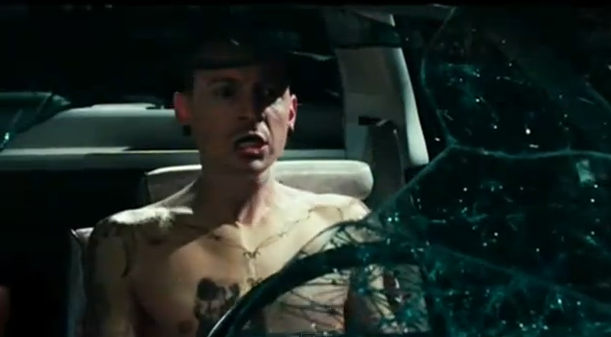
Really starting to think about the filming of our film opening, I decided to do a deconstruction on the points of view portrayed through camera angles and editing within different films.
First of all, I wanted to look at the way the camera portrays the point of view of the victim through angles, still making them look like a victim within the sequence. This is a favoured type of point of view to portray within a Horror/Slasher movie as it gives opportunity to create "jump" scares and red herrings, tension when it is unclear what is going to happen next and terrifying mystery when the audience is forced to go into darkness, not knowing what is within it. It also gives opportunity to add "clues" for the audience to decipher who killer is and why he wants to hurt his victims.
Saw 3D
I looked at Saw 3D first, a well known, successful slasher film, to see how the many victims within it are shown with camera angles, and how their points of view are portrayed on screen.
To the left and right shown screen grabs of a few of the different victims within the film. The scenes that they are in show their points of view, and I wanted to see how they did this.
The first thing that I noticed was that their faces are used as a visual aid in deciphering their emotions and thoughts at each time, having close up shots on this.
They generally have mid shots of the victims rather than showing their entire bodies, to emphasis the idea of "fight or flight" reaction and the fact that their self survival is all in their mental ability to get out of the "trap" that jigsaw has placed them under. The only exception to this is when the victim wakes up, from having been taken by jigsaw, and the situation that they have been put in is revealed to the audience so they know what is happening with establishing shots of the room and mechanism they have been put in.
Scream 4
The majority of Scream 4 is in the victims point of view. Most of the death scenes are shown in the You Tube clip embedded.
The different ways that I noticed that the camera represented the victim's point of view were firstly they had close up shots of their faces- just before the killer started to attack them. The face was illuminated with high key lighting in a generally low key lighted surroundings, so that the audience can see the victims emotions at that time.
Throughout the "chase" of the victim by the killer, the camera always followed the victim running firstly, and then as the victim hid somewhere, it would stay with the killer, to show the audience what is happening, opposed to only letting them know as much as the victim would know in that circumstance.
Camera angles also changed when in the victims point of view, with high angle shots, making the victim look more venerable, reflecting their terror in the image shown on screen.
Finally the lighting was another interesting feature within the death scenes. The victims were always much more illuminated than the killer, and, as seen in the last three screen shot above, when the victim is on screen, and hurt, the killer is always in the shadows, in the background, symbolising the fact that the victims are no longer concerned with the killer hurting them, as they already have been hurt, they are simply thinking about themselves- this is what the audience would be thinking also because of the positioning and lighting reflecting this view on screen.
Having looked at the victims point of view- an aspect that we may wish to use within our film opening-, I am now going to look at the point of view of the killer. This is POV not widely used, as it takes the element of terror at not knowing who the killer is, or what his/her story behind the killing is. It reveals the killer to be what he/she is, letting the audience see them completely, making it harder to scare them with "jump" shots. This also brings psychological components, making the audience think into the mind of the killer.
Killer and his "Father" conscience
Dexter
The first thing that I thought of when the idea of the killers point of view came up, was "Dexter". This, though a television series, is in the point of view of a serial killer named Dexter. From the very beginning, the series starts with it being in his point of view, and until it ended, the series was very popular, especially in America.
Features within this TV series that make it a good "killer's point of view" include the continual close up shots of the killer's face, showing his emotions and relaying his thoughts through his facial features.
A voice narrative symbolising the killers thoughts is also used to allow the audience to get a better idea of what the killer is thinking, used mostly when he is stalking his victims or when he is worried about getting caught.
The killer's father- Harry- appears when he is struggling with something or making a decision that could effect his future. His father, being dead, is just a ghostlike portrayal of the killers mind and conscience, reasoning with him to make him make decision such as would not get him caught killing people. The fact that this "conscience" appears to the killer as his father symbolises "daddy issues" that are present also.
The Fall
The fall is another really good TV series that shows the killer's point of view. A few of the different techniques that represent the killer's POV are shown below:
Close ups of the killer's eyes are used to show his emotions during his kills.
The camera also follows the killer, and the audience are exposed to scenes and scenarios that they wouldn't see if it was in the point of view of the victims.
Following the killer, it allows the audience to get an idea of what his "ritual" of killing is and why he does it. You get to see his ability to kill, his planning, his technique and understand it, rather than are afraid of it.
Low key lighting is used to make the killer look as if he is in the shadows again, like in the scream deconstruction of the victims POV, but the shadows represent something different- his ability to get away with what he is doing and still be able to have a normal family and life.
The killer is always the subject of the scene. It is focused on him when he is in the shot. This lets the audience see inside of the killer's mind linking to the physiological aspect of looking at the killer's POV within a film.


 This is what our 2 actors looked like at the end of hair and make-up. Overall, the preparation went successfully as our actors looked how we wanted them to, especially the special fx make-up on the killer which looked good after Annie had tried out so many variations of it.


 Also, Annie and Hayley poured some fake blood on the branch and the leaves underneath and I filmed the killer approaching this. Meanwhile, Annie was applying the victim's wound from the branch so we saved time and when that was done, we filmed her being cut by the branch.


 After we finished filming that, it began to get very dark, as mentioned, so when we found a thick enough tree for the victim to hide behind, we needed artificial lighting. Annie filmed the last few shots and Hayley and I held the lights. While Hayley and Annie were setting up, I directed the actors on what they had to do. All this saved time as we knew it was getting dark quickly. The lights were small which meant they did not project masses of light onto the actors which was good because when we watched over the recordings, the surroundings were dark and only the victims faces were illuminated, making the scene more scary and fitting with horror and slasher conventions of darkness to reflect the killer's inner darkness.