Wednesday, 13 November 2013

Point of view- Victim/Killer Deconstruction

Really starting to think about the filming of our film opening, I decided to do a deconstruction on the points of view portrayed through camera angles and editing within different films.

First of all, I wanted to look at the way the camera portrays the point of view of the victim through angles, still making them look like a victim within the sequence. This is a favoured type of point of view to portray within a Horror/Slasher movie as it gives opportunity to create "jump" scares and red herrings, tension when it is unclear what is going to happen next and terrifying mystery when the audience is forced to go into darkness, not knowing what is within it. It also gives opportunity to add "clues" for the audience to decipher who killer is and why he wants to hurt his victims.

Saw 3D

I looked at Saw 3D first, a well known, successful slasher film, to see how the many victims within it are shown with camera angles, and how their points of view are portrayed on screen.
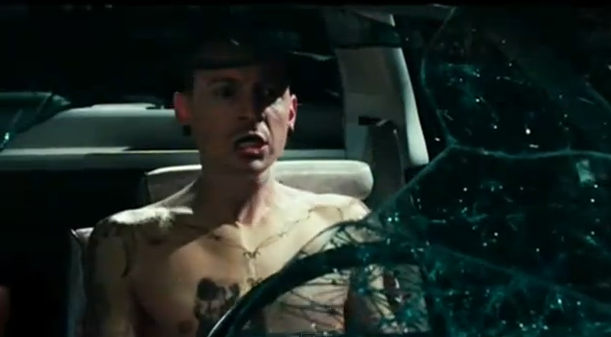
To the left and right shown screen grabs of a few of the different victims within the film. The scenes that they are in show their points of view, and I wanted to see how they did this.
 The first thing that I noticed was that their faces are used as a visual aid in deciphering their emotions and thoughts at each time, having close up shots on this.

They generally have mid shots of the victims rather than showing their entire bodies, to emphasis the idea of "fight or flight" reaction and the fact that their  self survival is all in their mental ability to get out of the "trap" that jigsaw has placed them under. The only exception to this is when the victim wakes up, from having been taken by jigsaw, and the situation that they have been put in is revealed to the audience so they know what is happening with establishing shots of the room and mechanism they have been put in.

Scream 4

The majority of Scream 4 is in the victims point of view. Most of the death scenes are shown in the You Tube clip embedded.

 The different ways that I noticed that the camera represented the victim's point of view were firstly they had close up shots of their faces- just before the killer started to attack them. The face was illuminated with high key lighting in a generally low key lighted surroundings, so that the audience can see the victims emotions at that time.


Throughout the "chase" of the victim by the killer, the camera always followed the victim running firstly, and then as the victim hid somewhere, it would stay with the killer, to show the audience what is happening, opposed to only letting them know as much as the victim would know in that circumstance.


Camera angles also changed when in the victims point of view, with high angle shots, making the victim look more venerable, reflecting their terror in the image shown on screen.

Finally the lighting was another interesting feature within the death scenes. The victims were always much more illuminated  than the killer, and, as seen in the last three screen shot above, when the victim is on screen, and hurt, the killer is always in the shadows, in the background, symbolising the fact that the victims are no longer concerned with the killer hurting them, as they already have been hurt, they are simply thinking about themselves- this is what the audience would be thinking also because of the positioning and lighting reflecting this view on screen.

Having looked at the victims point of view- an aspect that we may wish to use within our film opening-, I am now going to look at the point of view of the killer. This is POV not widely used, as it takes the element of terror at not knowing who the killer is, or what his/her story behind the killing is. It reveals the killer to be what he/she is, letting the audience see them completely, making it harder to scare them with "jump" shots. This also brings psychological components, making the audience think into the mind of the killer.

Killer and his "Father" conscience

Dexter

The first thing that I thought of when the idea of the killers point of view came up, was "Dexter". This, though a television series, is in the point of view of a serial killer named Dexter. From the very beginning, the series starts with it being in his point of view, and until it ended, the series was very popular, especially in America.

Features within this TV series that make it a good "killer's point of view" include the continual close up shots of the killer's face, showing his emotions and relaying his thoughts through his facial features.

A voice narrative symbolising the killers thoughts is also used to allow the audience to get a better idea of what the killer is thinking, used mostly when he is stalking his victims or when he is worried about getting caught.

The killer's father- Harry- appears when he is struggling with something or making a decision that could effect his future. His father, being dead, is just a ghostlike portrayal of the killers mind and conscience, reasoning with him to make him make decision such as would not get him caught killing people. The fact that this "conscience" appears to the killer as his father symbolises "daddy issues" that are present also.

The Fall

The fall is another really good TV series that shows the killer's point of view. A few of the different techniques that represent the killer's POV are shown below:

Close ups of the killer's eyes are used to show his emotions during his kills.

The camera also follows the killer, and the audience are exposed to scenes and scenarios that they wouldn't see if it was in the point of view of the victims.

Following the killer, it allows the audience to get an idea of what his "ritual" of killing is and why he does it. You get to see his ability to kill, his planning, his technique and understand it, rather than are afraid of it.

Low key lighting is used to make the killer look as if he is in the shadows again, like in the scream deconstruction of the victims POV, but the shadows represent something different- his ability to get away with what he is doing and still be able to have a normal family and life.

The killer is always the subject of the scene. It is focused on him when he is in the shot. This lets the audience see inside of the killer's mind linking to the physiological aspect of looking at the killer's POV within a film.

Thursday, 7 November 2013

Practical Investigation of Mise En Scene of Killer's Den

I attempted to make my garage look like the killer's den. and worked in sections as that made it easier for me. Whilst working I realized just how small my garage is, thus making it harder for me to do the mise en scene. This may be advantageous because the smaller it is, the more intense, however, in terms of recording with lighting, props and the crew, the size would be a disadvantage.

I mostly focused on the desk and the area near the shutter as this is where the killer will be during most of the opening. We have not worked out what our desk will look like yet, and as this is a rough plan, I improvised and used old sheets of paper and placed them on top of an old TV stand (the desk). Next to the desk is where the killer's weapons will be. Having a closed box for where the weapons will be kept is intriguing because the audience will start to think about what is in the box. During the opening, we will have a few flashbacks to when he is operating on his victims and this may be when we see what is in the box, if we are to incorporate a weapons box.


 Behind the desk there will be a black bin bag, which again the audience will question, and my group and I were thinking of having a bloody hand coming out so the audience know what is in there. This will also make the killer look ruthless and cold-hearted because he sees his victims as objects, not people.
This is what the garage may look like in the final project if we are to use this garage. There will be paper scattered on the floor to show his carelessness. As an addition idea, there could be some blood splattered on the shutter, and because it is white, the blood would be more prominent. Also, we could put some bloody hand prints along the walls from where victims have tried to escape.


 The mattress was placed in the middle of the garage and it is very old and is ripped so we can see the springs. This would be a good prop to use because it is already dismantled and dirty, again emphasizing his negligence of where and what he uses to kill his victims, he just wants them (and their fetuses) dead. Next to mattress, however, he could have some plastic around it so that no blood gets on the floor. This obviously clashes with the careless attribute associated with him, but it could also make it look even more disturbing - that he allows bloody handprints on the walls but wants a clean floor. Often, killers have strange habits and this helps add to their mysterious character.

This is the mattress and around it, it's dirty and there is a saw on it. This was an improvisation as we have yet to plan which tools he will use to cut open his victims. Saws are less medical and safe ways of cutting open victims, if a saw was used it would be very painful for the victim and more blood and pain is a very common slasher convention.

The problem with my garage, as mentioned before is that it is very small. Especially with the shelves in the corner and mattress in the middle, it limits the space further. It would be impractical to use this garage, however, if we plan the space properly so the crew, props and tools could fit, we could use this garage and would work well as a killer's den.

Deconstruction of Killer's Den:

Deconstruction of the killers den:

ATM (2011):

~ In ATM, three colleagues are trapped in an ATM by an unknown man, two of them die and the third one is framed for the crimes (as 'THE MAN' did not make himself shown on the security cameras), in the final scene of the film, the hooded man is returning to his lair (a storage locker). It all looks normal until he moves a few boxes and we can see there is a hidden room behind one of the walls, containing all of his information.

The Man opening the locker.

~ I like this shot as I think the silhouette of the hooded man is really effective against the white of the locker. We still don't know who the hooded man is and I think it is clever that he does not have an identity or personality at all. I think we should definitely consider the idea of the killer remaining anonymous, or only revealing certain aspects about him as it can be good to leave the audience in the dark for the majority of the film. I also think that if the majority of our film opening is filmed in the killers den, it would be extremely important how we should the location on screen and the mise en scene. The killers den is often an extremely vital insight into the life of the villain and who he is exactly.

The 'normal' room.

Secret door.

~ I also like the idea of the villain having a way of stopping people from entering their den, like seen in ATM, he has a normal room, so if someone were to open the locker accidentally, then they wouldn't be suspicious of what they would find, as it all seems like a normal storage locker. I think when considering the location of our villain's den, it would be important to consider how easy it would be for someone else to enter it, for example the police, if making a raid. Also the idea of a secret room shows his intelligence and his urgency of not wanting to be found.

Sitting at his desk.
''
Desk

~ Then we get a shot of the wall above his desk, and it is filled with bits of paper which we find out are things like maps, pictures and blueprints. This shows that all of his murders are extremely planned out, and the pictures of the security cameras with details is clever, meaning that he is never caught on tape and so is never seen as playing a part in these crimes, making the victims themselves look extremely suspicious and often getting blamed for the murders.


~ The fact that the lighting comes up through the tracing paper makes his hands look darker and more like a silhouette, adding to the creepy effect. We can also see the detail that he goes into when annotating his sketches and blue prints. A small detail but important, the pen he uses is red, symbolising the blood of his victims, it's the small details like these which can be really effective if the viewer is paying enough attention to pick up on them and that is why mise en scene is extremely important in a killers den.


~ Here are some more examples of the things located around his desk. There are the blueprints of a building and he would need to use these to plan out exactly where everything will happen, including himself. The picture of the security camera looks like he has taken it himself and I can personally imagine him going to these areas before hand, to check whether they would be suitable for his plans. He's also written on it that the focal length is 120, this would be useful so he knows where to stand without being seen clearly but also must be quite difficult to find out, assuming he had to research the specific type of camera and this shows the depth he goes into to find out out the correct information.

~ There are also a few maps on the wall, this would be needed so he knows where the best locations are to commit this type of murder, obviously he likes the idea of ATM's and my guess is that he goes to all the local ATM's and checks whether his idea would work successfully or not. In the last screenshot, he is drawing a line with a ruler, I particulary liked this as I thought it represents his mind almost, that everything single thing has to be precise and accurate and that everything must go according to plan.

~ I believe that the general area that our film is set in, isn't as imporant as some other aspects as we are limited with locations to choose from, not being able to travel too far. I think it would be more important and also effective to focus on the killers den, as the villain is the main part of our film opening, and with our current idea we are planning on focusing on them more with flashbacks of their previous murders, and if they are mostly inside then the outside location isn't as important as the inside of their den.

Monday, 4 November 2013

Deconstruction of Tied Up Victims & Mise en Scene & Lighting


 In Se7en, seven people are killed and 2 of them were tied up. The Sloth sinner was tied to a bed for a year and his body began decaying - he was tied using leather belts and is blindfolded. Many people own leather belts so using those makes the crime seem more realistic and believable. The Sloth is in a bedroom which looks normal - there is a bed, a hospital trolley with a lamp and dozens of drugs on it, chairs around the room, and many tree car fresheners hanging from the ceiling to mask the smell of the decaying body.

The second victim has committed the sin of gluttony, he is obese, tied up and forced to eat so much that his stomach bursts thus killing him. He is tied using barbed wire which prevents him from moving because it cuts into his skin. This ties in well with the slasher convention of making the victim suffer as much as possible, for the killer's pleasure. If we were to use barbed wire in our project, the would implement the slasher genre to our audience.
The kitchen which he is in is dark and very dirty with cobwebs. The drawers are old and very unclean and there are insects feeding on thr food on the table. The use of insects makes the audience squirm and makes the crime (snd scene) seem even more sickening.


In The Exorcist, the possessed girl is tied to her bed using long white strips of tightened fabric which does not seem as painful as barbed wire, but would still hurt her if she pulled on it. Her wrists and ankles are tied to everywhere around the bed to ensure she stays there. She is only young so her being treated like this makes the audience sympathetic towards her. However, once you see her face and how she behaves, you soon think otherwise. The bedroom she is in is undecorated, with dull colours used, and not very homely with pictures or teddy bears anywhere. This blandness puts more emphasis on the girl and the state she's in. Also, it creates s sense of eerieness in that no one has bothered to decorate it to make it look nice and for her to enjoy it.

In I Spit On Your Grave 2, one of the wonan's victims is tied against a wall using thick brown rope which does not look painful, but in fact is very harsh as it rubs against the skin. This leads to cuts and blisters which, again, is the typical slasher convention of causing pain and repulsive injuries. The man has been stripped of his clothing so his cuts and blood are visible to the audience. This tells them that the torture is not over and this is what grips the audience because they want to find out what happens next to the victim. The mise en scene used is very simple, he is tied to an undecorated brick wall which is crumbling, with the cement between the bricks visible to show that no care was given when making it. Also, he is tied up in a secluded place which is why it was never decorated because no one was really supposed to go there - a typical slasher convention of secluded places for murdering.

In True Blood, one of the characters is tied to a bed with his shirt undone so we can see the several cuts and blood smeared across his chest - similar to I Spit On Your Grave. The bed he is tied to is a simple metal bed with a dirty mattress on it. His wrists are tied using leather straps/belts and his ankles rope. These two materials are a typical horror and slasher convention to use when tying up someone. Low key lighting is used so the audience cannot see much of the room. From what we can see, it is not very decorated, and there is a shelf with jars and pots on it on top of the bed and a small ladder next to the bed. From this, we may infer that he is in a garage which is a small confined place where people normally expect cars to be, not injured victims.

The theme with all these deconstructions I have chosen is that the victims are tied using rope or leather belts. As mentioned above, these are materials found in any home which is what makes the death/torture seem even more realistic and this haunts the audience. A lot of the people are tied to beds because it is ironic - beds = comfort and relaxation, and the victims finitely are not comfortable or relaxed, you sleep on them and sleep = vulnerability, as they are tied up they are exposed for the killer to do anything to them. Also, when someone is being killed, low key lighting is a very common horror and slasher convention because darkness = bad and you cannot see well in low key lighting so it, again, makes the victim more vulnerable which scares the audience because anything could happen to them.

Death Scene Number One- Trial

For my practical investigation this week, I have decided to do one of the death scenes that will be shown in the film opening as a photo in the diary and/or a small clip- as if a memory.

However, during the half term that I had to do this, I could not find any willing participants to be the model for this scene as it was inconvenient for them to come over at one time, or they were busy doing other things. In the end, I had to do it as a last minuet thing with my sister, who was not very willing, but agreed to help me out. This was quite worrying to me, being that if someone couldn't give up an hour or two of their time, how would we get a few people to do the whole film opening. This is an issue that we will have to address soon.

So on the day before we went back to school, I attempted to create this scene:

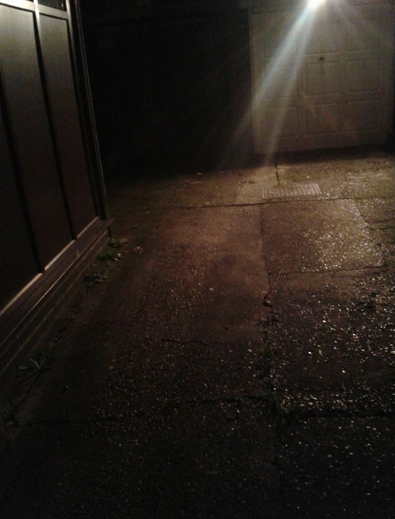
The location of this death scene is an alleyway next to my house, at around 5 pm. The location is shown in the pictures to the left and right, and as shown, I experimented with the lighting before hand to get an idea of what type of lighting would be appropriate.


To the left you can see the motion sensor light from the garage, giving off a visible beam towards the ground in front of the building. This could be where the body is shown.

To the right is the same alleyway, but with the main light not working and a pale light shining towards garage. This low- key lighting gives an eerie effects, adding tension to the image.

To the left is another low-key lighting effect, however, the camera is angled towards the garage, coming from the wall, as if its in the view of someone who is hiding- possibly in the killers point of view.

The final photo to the right shows an even darker lighting, illuminating only a small section, making the image go into darkness- adding to the tension and the fear of the unknown.

After putting the special effects makeup on my model, I positioned her on the floor of the alleyway, as if she had been attacked and murdered- her throat slashed. Below shows the shots of this scene:

 To the left and right shows my model at a close up shot with her throat slit and blood on her shirt, with bruises on her face, and dirt on her all over her- as if she had been in a struggle, restrained and murdered.
The lighting is quite high-key, illuminating the face- the photographs would be more appropriate as police shots of a victim than the killers shots of his work, or a memory- not wanting to be caught, and more subtle when killing the victim.

The photograph to the left has more appropriate mise en scene, being that the victims eyes are closed, the blood is illuminated against the light shirt, and the lighting is more low-key, for the killers memory, or is photograph of his victim.

The final photo above shows my victim from further away, the light from the motion sensor light streaming down on her. It is, however a photo that would not be taken by the killer- or be in his memory of his victim, as the mise en scene isn't quite right.

The finished result of this first death scene for our killers diary turned out to be okay, however, I do feel that we need to do it again, using this as a trial death scene and an example of what obstacles we will have to avoid or overcome. I will be doing another post, planning the death scenes that we are going to create- where they will be located, the way the killer will kill his victim and the type of person that our killer is going to be focusing on.

Saturday, 2 November 2013

Practical Investigation: Survey

Survey:

~ My practical investigation was to create a survey that we could use to find out the public opinion on our ideas for our film opening. I used the website Survey Monkey and we had a target of 70 responses.

This is our survey.

We based a lot of our questions on the villain in the hope of building a strong yet realistic character which would appeal to the public. First of all we asked about their age and gender, so we could get a general idea of what the public would consider the 'ideal' villain for a slasher film.

Question 1 and 2

Secondly we wanted public opinion on two of our main features about the villain, whether they would find the villain keeping a diary and a souvenir from each murder effective or not, or if it would depend on how we filmed it for example.

Question 3 and 4


Then we wanted to know how they thought they should be shown, if they wanted them to remain anonymous or to know who it was and if so, how should we portray them, such as what camera angles/shots should be used.

Question 5 and 6

Next we wanted to know about including a death scene, as they are one of the main aspects of a slasher film but could be extremely difficult to show successfully. We asked whether we should include it (as a lot of films don't really have an actual death scene in the first two minutes) but if we did, whether it would be better to have it as gory as possible, representative of our slasher genre or more suggestive which could look more professional.

Question 7 and 8

We were also interested to hear what sounds people thought we should have in the opening, if they wanted more diegetic sounds (what was happening in the scene) or non diegetic sounds such as music or a voice over.
Finally we wanted to see what horror/slasher films people thought were successful, so we could take aspects from the more popular films and see what to avoid from the less popular ones.

Question 9 and 10

All of the responses to these questions will be important in helping us decide key aspects of our film opening and whether or not they would be effective.